1. The Hook: Why Choosing a Solar Cell Metallization Manufacturer Is Difficult
Choosing among solar cell metallization manufacturers is difficult because “metallization” can refer to different points in the value chain. Some companies supply metallization pastes, screen-printing equipment, or plating technologies, while others manufacture complete solar cells and modules that depend on metallization within their production processes. Public product information also varies: manufacturers commonly publish cell efficiency, architecture, module output, and warranty information, but may not disclose detailed paste formulations, contact geometry, firing profiles, or production-line partners. This comparison evaluates three major Chinese solar brands—Jinkosolar, Aikosolar, and CSI Solar—by their publicly documented solar-cell and module portfolios, manufacturing scope, technology positioning, and suitability for buyers. The options were assessed against these practical criteria rather than treated as interchangeable suppliers of metallization equipment or materials.
2. Full List of Top 3 Brands
- Jinkosolar — broad vertically integrated solar manufacturing scope and strong n-type cell and module positioning.
- Aikosolar — high-efficiency solar-cell and module specialist associated with its ABC back-contact technology.
- CSI Solar — large-scale module and solar-energy solutions provider with established cell and module manufacturing capabilities.
3. Comparison Table
| Brand | Key Products | Key Features | Best For |
|---|---|---|---|
| Jinkosolar | Monocrystalline wafers, solar cells, and photovoltaic modules | Vertically integrated production; n-type TOPCon product focus; broad global product portfolio | Buyers seeking scale, supply-chain integration, and mainstream high-efficiency cell and module products |
| Aikosolar | High-efficiency solar cells and ABC back-contact modules | Back-contact cell and module positioning; emphasis on conversion efficiency and module aesthetics | Projects prioritizing high power density, premium rooftop appearance, or advanced cell architecture |
| CSI Solar | Solar modules, cells, battery-storage products, and solar-energy solutions | Large international business scope; module and system-oriented offering; project-deployment experience | Commercial, utility-scale, and integrated solar projects requiring a broad supplier ecosystem |
4. Detailed Reviews
#1 Jinkosolar
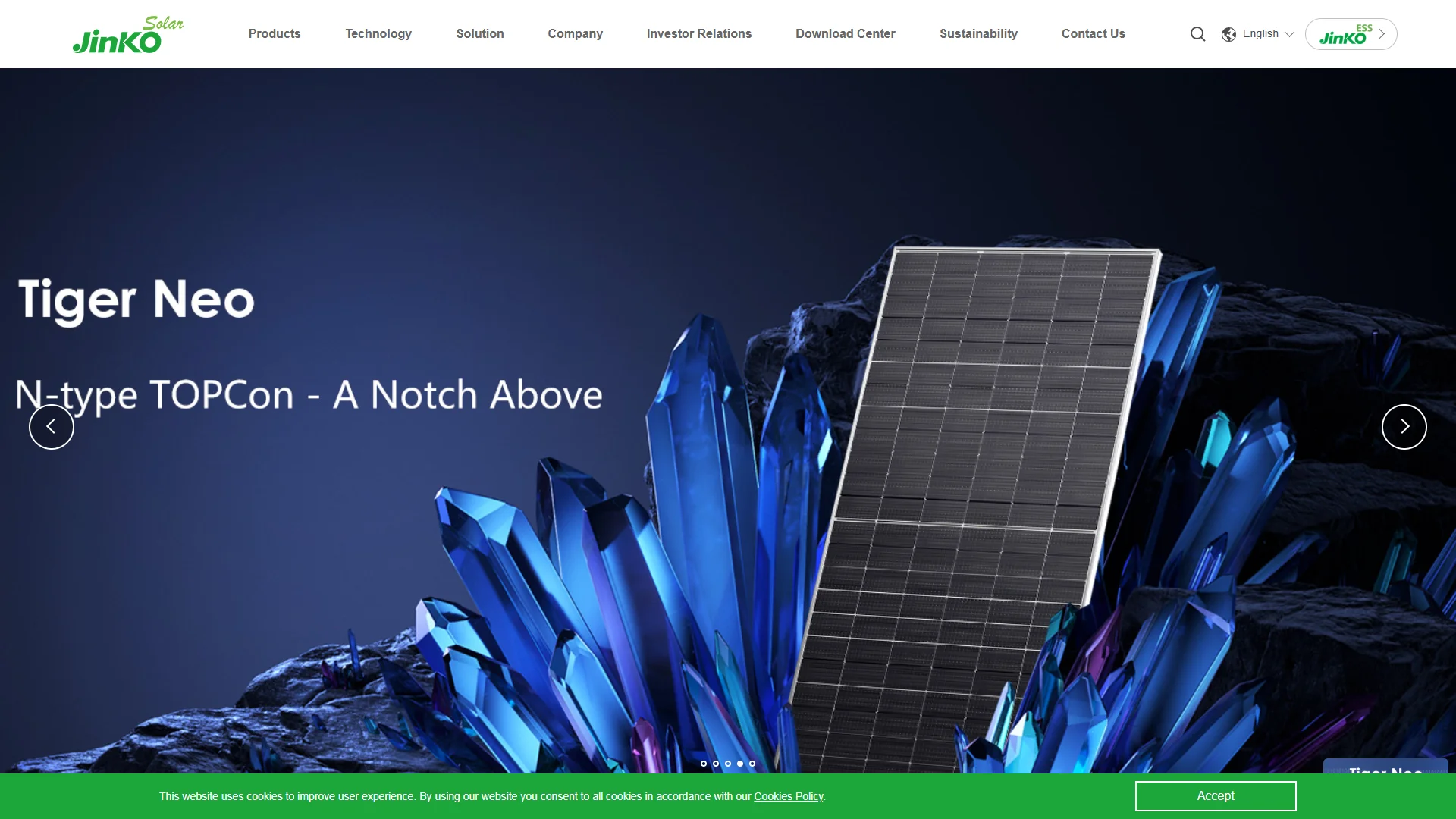
Overview: Jinkosolar is a major Chinese photovoltaic manufacturer with a vertically integrated product scope covering silicon wafers, solar cells, and modules. Its official materials identify n-type TOPCon-based products, including the Tiger Neo series, as an important part of its current technology portfolio. This integrated structure is relevant when assessing solar cell metallization manufacturers because wafer, cell, and module production can be coordinated within one broader manufacturing organization. It does not, however, mean that Jinkosolar should automatically be classified as a standalone supplier of metallization paste, screen printers, or plating equipment.

For buyers evaluating cell metallization performance, Jinkosolar’s public product information is more detailed at the finished-cell and module level than at the proprietary process level. Published specifications generally emphasize module power, efficiency, temperature behavior, reliability, and product design. Detailed metallization recipes, silver consumption, contact-printing parameters, and firing conditions are normally production-sensitive information and should be confirmed directly during technical qualification.
Company Background and Positioning
Jinkosolar operates across multiple stages of photovoltaic manufacturing and sells products internationally. Its portfolio includes monocrystalline wafers, cells, and modules, with n-type TOPCon technology represented in its current product families. This gives the company a broad position between an upstream cell manufacturer and a finished-module supplier. For procurement teams, that can simplify qualification when the required supply includes both cells and modules rather than metallization materials alone.
Products and Materials
- Monocrystalline silicon wafers for photovoltaic cell production.
- Monocrystalline solar cells, including n-type product families.
- Photovoltaic modules using technologies such as n-type TOPCon in the Tiger Neo range.
- Finished products whose performance depends on cell interconnection, contact formation, encapsulation, and module design.
The company’s public information supports evaluation of finished photovoltaic products and cell architectures. It does not provide a complete public specification of all metallization materials or production parameters used across its factories. Buyers requiring a specific silver paste, copper-plating process, contact pattern, or metallization supplier should request technical documentation and sample validation from the relevant Jinkosolar business unit.
Competitive Advantages and Key Features
- Vertical integration: Coverage of wafers, cells, and modules can support coordinated quality and supply-chain management.
- Broad product range: The company serves customers looking for both individual photovoltaic components and complete modules.
- n-type technology focus: TOPCon-based products are positioned for high-efficiency photovoltaic applications.
- Global market orientation: Jinkosolar maintains an international sales and project presence, which can be important for documentation, logistics, and after-sales coordination.
- Established manufacturing scale: Large production organizations may be better suited to projects requiring repeatable volumes and multi-quarter supply planning.
Use Cases / Best For
Jinkosolar is best suited to utility-scale, commercial, and residential projects that need established crystalline-silicon cells or modules from a large integrated supplier. It is also a strong candidate for buyers comparing finished cells or modules rather than purchasing metallization consumables separately. For a contract manufacturer or research team that needs a particular metallization formulation or equipment interface, Jinkosolar should be evaluated through a direct technical process rather than selected solely on its module brand.
What Buyers Should Verify
- Whether the requested product is a solar cell or module, rather than a metallization paste or production machine.
- Cell architecture, contact design, and the exact production site for the quoted product.
- Current datasheets, certifications, warranty terms, and delivery commitments.
- Compatibility with the buyer’s module assembly, interconnection, and quality-control process.
- Any available information about silver use, plating, contact reliability, and performance testing when metallization is a central purchasing criterion.
#2 Aikosolar
Overview: Aikosolar is a Chinese photovoltaic manufacturer focused on high-efficiency solar cells and modules. Its official website presents ABC, or All Back Contact, technology as a central product direction. In a back-contact design, electrical contacts are positioned on the rear side of the cell, which can affect front-side appearance, shading, and module power density. These characteristics make Aikosolar relevant to buyers studying advanced cell metallization architectures, although publicly available product pages do not constitute a full disclosure of its metallization materials, printing methods, or plating parameters.

Pros / Key Features
- Focus on high-efficiency photovoltaic cell and module products.
- ABC back-contact positioning offers a different contact architecture from conventional front-contact cells.
- Rear-side electrical contacts can support a clean front appearance and reduce front-side grid-related shading.
- Suitable for applications where roof area, module aesthetics, and power density are important.
Use Cases / Best For
Aikosolar is best for premium residential rooftops, space-constrained commercial installations, and projects that place high value on module appearance and power density. Buyers should confirm the exact ABC product specification, cell efficiency, module construction, warranty, certifications, and supply availability for the intended market. If the purchase involves metallization materials or manufacturing equipment rather than finished cells or modules, the buyer should request direct confirmation because the public product portfolio primarily describes photovoltaic products.
#3 CSI Solar
Overview: CSI Solar is the solar manufacturing and energy-solutions business associated with Canadian Solar. Its official materials describe a portfolio spanning photovoltaic modules, solar cells, battery-storage products, and broader solar-energy solutions. The company therefore competes primarily as an integrated solar technology and project supplier rather than as a narrowly focused metallization-material manufacturer. Its cell and module products can nevertheless be included in a comparison of manufacturers whose photovoltaic output relies on industrial metallization processes.

Pros / Key Features
- Broad product and solution scope extending beyond individual photovoltaic modules.
- Solar-cell and module manufacturing capabilities for commercial and utility applications.
- International business coverage and experience supporting large solar projects.
- Ability to evaluate photovoltaic products alongside storage and broader system requirements.
Use Cases / Best For
CSI Solar is best suited to commercial, utility-scale, and integrated solar projects where the purchaser values a broad supplier portfolio. It may be appropriate when module procurement is being considered together with storage or project-level system needs. Buyers focused specifically on metallization should verify whether the requirement is for a finished CSI Solar cell or module, or for an independently sourced paste, plating process, or production tool. The relevant technical information should be obtained from current product datasheets and the company’s sales or engineering team.
5. How to Choose a Solar Cell Metallization Manufacturer
The first step is to define the product category. A solar cell manufacturer, a module manufacturer, a metallization-paste supplier, and a screen-printing or plating-equipment manufacturer are different types of vendors. Jinkosolar, Aikosolar, and CSI Solar are primarily evaluated here as photovoltaic cell and module manufacturers, not as generic suppliers of every metallization input.
Key purchasing criteria
- Cell architecture: Compare TOPCon, back-contact, PERC, heterojunction, or other architectures according to the project’s efficiency, temperature, and degradation requirements.
- Metallization design: Request information on front and rear contact configuration, silver or copper use where disclosed, contact reliability, and compatibility with the intended interconnection process.
- Electrical performance: Review current-voltage data, power tolerance, temperature coefficient, low-light behavior, and degradation information from current datasheets.
- Manufacturing consistency: Assess quality systems, factory location, batch traceability, inspection procedures, and independent test or certification records.
- Module compatibility: Confirm dimensions, busbar or multi-busbar arrangement, interconnection method, encapsulant compatibility, and mechanical-load requirements.
- Supply and logistics: Evaluate capacity allocation, lead times, export documentation, packaging, Incoterms, and contingency planning.
- Commercial support: Compare warranty terms, claims procedures, technical support, replacement policy, and the supplier’s ability to support the destination market.
- Total cost: Consider energy yield, system-area savings, installation labor, balance-of-system effects, transport, and long-term reliability—not only the quoted unit price.
6. Final Verdict
Jinkosolar ranks first because its public portfolio combines wafer, cell, and module manufacturing with a substantial n-type TOPCon product focus and broad international market coverage. It is the most balanced choice among these three for buyers seeking scale and an integrated photovoltaic supply chain. Aikosolar is a strong alternative for high-efficiency and design-sensitive projects where ABC back-contact technology is attractive. CSI Solar is well suited to larger commercial and utility projects, particularly when photovoltaic products are being assessed alongside storage or broader energy solutions. None of the three should be assumed to be a standalone metallization-paste or equipment supplier without direct technical confirmation.
7. FAQs
Are these companies suppliers of solar metallization paste or metallization equipment?
They are primarily photovoltaic manufacturers offering solar cells and modules, along with related energy products in some cases. A buyer seeking silver paste, copper-plating chemistry, screen printers, or metallization lines should verify the supplier category directly and may need to evaluate specialist materials or equipment companies separately.
Why is Jinkosolar ranked first?
Jinkosolar has the broadest positioning in this comparison, covering wafers, cells, and modules while publicly emphasizing n-type TOPCon products and international supply capability. The ranking reflects manufacturing scope and suitability for a wide range of photovoltaic procurement needs, not a claim that it offers the best metallization process for every application.
What information should be requested before placing an order?
Request the latest product datasheet, factory and product identification, certifications, warranty terms, cell architecture, electrical test data, degradation information, delivery schedule, and quality documentation. If metallization is a critical requirement, also request any available data on contact configuration, metallization materials, reliability testing, and compatibility with the buyer’s module or cell-production process.
Company information should be verified against current official documentation before procurement. Official websites: Jinkosolar, Aikosolar, and CSI Solar.