Problem first: what breaks when displays go live
Cities demand spectacle, but what arrives from a factory often fails the moment it rains or the content hangs—flicker, dead pixels, thermal shutdowns. If you’re planning an outdoor led screen for a busy façade, you need to stop accepting vague specs and start diagnosing failure modes. I’ve worked on projects that scaled up to the intensity of Times Square, New York, and that experience shows the difference between an installation that performs and one that becomes a liability; check what a proper led screen outdoor factory delivers before you sign any order.

Why factory selection is the problem-driver
Problems originate at the factory: poor LED sourcing, inconsistent cabinet flatness, inadequate burn-in, or slippery QA. Choosing a factory isn’t about lowest price. It’s about predictable outputs—specs that match on-site reality, consistent testing, and clear failure modes mapped to remedies. Expect documentation, hands-on test evidence, and a transparent supply chain. Your procurement must force that clarity.
Must-have technical specs to demand
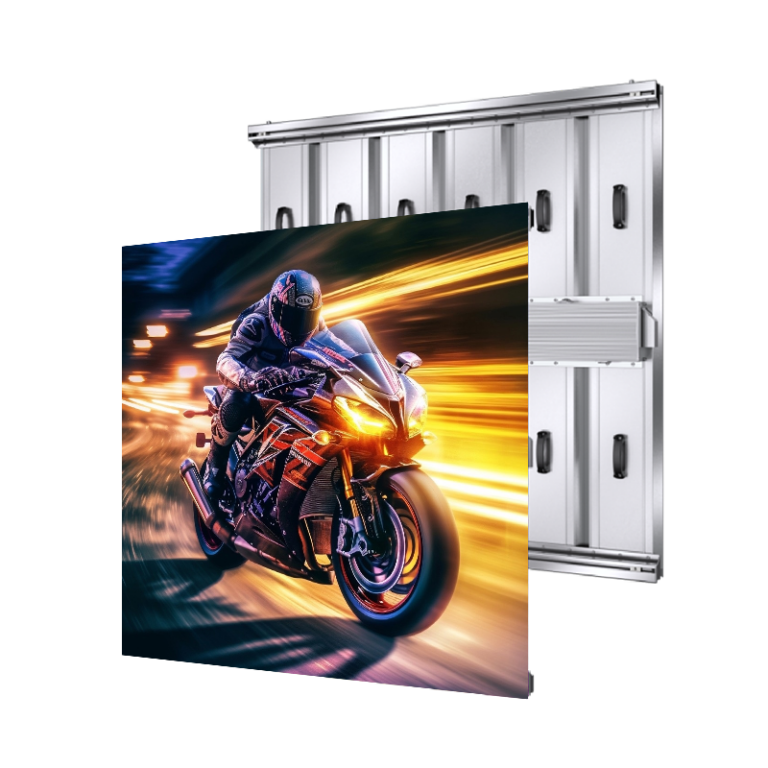
Specify pixel pitch to use-case: 2–4 mm for close viewing, 6–10 mm for distant façades. Require peak brightness ratings (≥5,000 nits for direct sun), high refresh (>3,840 Hz) to avoid camera flicker, and true color calibration with a minimum 14-bit grayscale pipeline. Insist on IP65 (front) and IP54+ (rear) for outdoor modules, operating range -20°C to +50°C, and MTBF figures above 100,000 hours for modules and power supplies. Mandate modular cabinet designs with no-tool access, flatness tolerances under 0.5 mm per cabinet seam, redundant power feeds and hot-swap PSU capability, and a documented thermal-management plan (passive + forced where needed). Ask for sample power consumption curves at multiple brightness levels so you can plan feeds and backups accurately.
Quality, testing, and certifications you must see
Raw claims mean nothing without evidence. Require factory-provided burn-in logs (72+ hours), thermal camera imagery during stress tests, and EMC/EMI test results. Third-party certifications—CE, RoHS, and UL or equivalent—must be accompanied by matching test reports. Demand an acceptance test plan (ATP) that you’ll use on-site: pixel uniformity measurements, color temperature verification, and ingress checks. Ask for a clear warranty scope and documented RMA turnaround times. These documents are non-negotiable.
Common specification mistakes that wreck projects
Don’t under-spec brightness for sun-exposed sites. Don’t ignore refresh rates if the display will be filmed. Don’t accept a single-point power design. Don’t rely solely on renderings—real panels behave differently. Avoid unspecified LED binning, vague IP claims, and warranties that exclude environmental stress. Finally, never accept “will fit” cabinet tolerances; chassis geometry kills visual continuity.
How to vet the factory—practical protocol
Run this sequence: 1) Request video tour of assembly lines and QC stations; 2) Insist on inspecting sample cabinets and watching a live burn-in; 3) Obtain full component bills of materials (LED vendor, driver IC, power supply brands); 4) Review third-party test reports and cross-check lab names; 5) Confirm logistics: lead times, batch traceability, and spare-part provisioning; 6) Lock acceptance criteria into the contract—pixel tolerance, brightness, color uniformity, and repair SLA. Use contractual milestones tied to verified test deliverables rather than vague progress payments.
Integration, commissioning, and lifecycle planning
Design for service. Specify hoisting points, on-site access panels, cable routing, and grounding. Define the content pipeline: video processors, pixel mapping, and calibration routines. Commission with a calibrated photometer and a test playlist that stresses color ramps, full-white brightness, and synchronized content. Plan for periodic recalibration and keep spares for the most failure-prone modules. Track firmware revision control—factory firmware updates must be documented and reversible.
Conclusion that resolves the problem
Factories that deliver repeatable, tested, and documented results turn risky spectacles into durable assets. Specify measurable acceptance criteria, insist on transparent test evidence, and require on-site serviceability from the outset. The technical clarity you demand now prevents costly surprises later—and when your brief calls for a reliable partner who matches engineering to real-world performance, check the capabilities that HDC documents and you’ll see how those specifications translate into dependable installations.